Protective Cases: Total Cost of Ownership Instead of Unit Price
5 Key Takeaways: Protective Cases: Total Cost of Ownership Instead of Unit Pr
- Topic: guide — industry context for B2B buyers and procurement teams
- Date: 2026-09-30 — current standards, certifications and market conditions
- Applications: protective cases for industrial tools, MRO, photography, drones, defense, medical devices, marine, audio
- Procurement: MOQ 500 pieces per Pantone color, 30–45 days lead time after tooling approval, CE/RoHS/REACH/ISO 9001/BSCI
- Shipping: EXW Guangdong (pickup) or FOB Shenzhen / Ningbo (sea freight). 28–35 days to Hamburg / Rotterdam
Direct answer: Compare protective cases by total cost of ownership per case per year, not by the price on the quote. A case that costs 30 % more but survives twice as many drops and gets returned half as often is usually the cheaper option within one to two years. The five costs that dominate are replacement of damaged cases, return and warranty logistics, freight and duty, internal handling labour, and the downtime caused by a damaged instrument arriving at the customer.
Why the unit price misleads
A quote shows the ex-works price of a shell. It does not show what happens after the goods leave the factory. If a case fails an ingress rating, it comes back, gets inspected, repaired or scrapped, and the replacement travels again. Each cycle adds freight both ways, inspection time, and the labour of the person who handles the return. On a case that ships with an instrument to a customer site and comes back damaged, the round-trip handling can approach or exceed the original unit price. That is invisible in a unit-price comparison.
The second blind spot is failure cost asymmetry. Losing a camera, a drone, a diagnostic laptop or a set of measurement instruments costs far more than the case protecting them. A buyer who optimises case price while ignoring instrument value is solving the wrong problem.
The five cost drivers
1. Replacement rate. Cases that are dropped, crushed in transit or opened daily fail at very different rates. Ask the supplier for their field return rate, not just their factory defect rate. A credible manufacturer will quote a number they can document.
2. Return logistics. A return shipment is expensive per kilogram because you pay for the outbound leg regardless. Consolidating returns into a scheduled batch instead of reacting case by case cuts this cost sharply.
3. Freight and duty. Under EXW Guangdong or FOB Shenzhen/Ningbo you carry the freight, so case volume matters. Nested cases that stack inside one another reduce cubic volume, and volumetric weight is what you actually pay for.
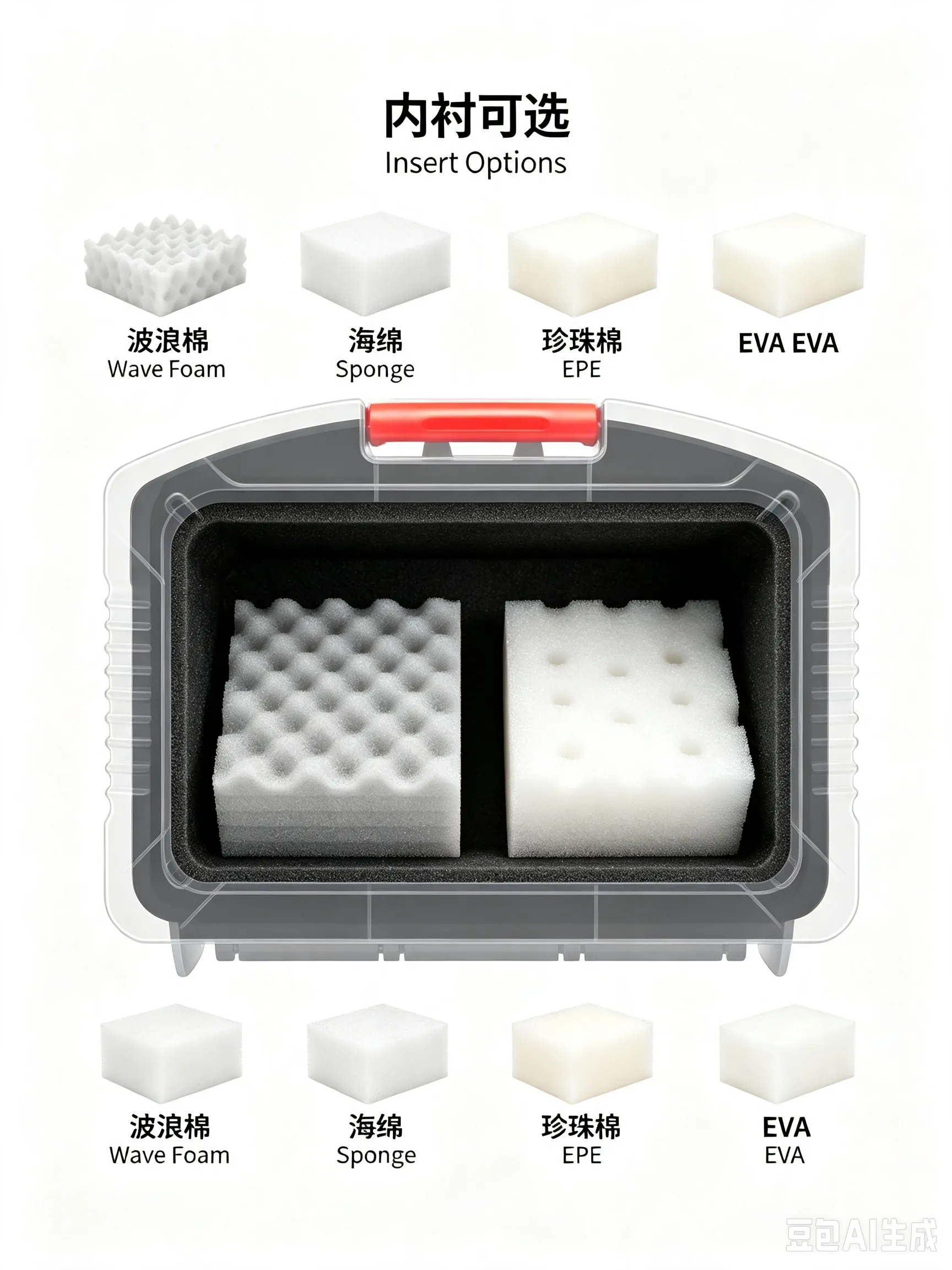
4. Internal handling. Foam inserts cut for the exact equipment save unpacking time. A wrong-sized insert means a technician rebuilds it on site; a correct one means the case opens and the instrument comes out ready to use.
5. Downtime. This is the largest and least visible. If an instrument arrives damaged, the user is idle for the duration of the replacement cycle. For a rental or field-service business this can exceed the entire annual case spend.
A worked calculation
Take a field-service company shipping 1,000 cases per year with an instrument worth USD 4,000. Over three years that is 3,000 cases and USD 12 million of instrument value in the field.
- Option A, economy case at USD 38, field return rate 6 %: 180 returns over three years.
- Option B, premium case at USD 52, field return rate 2 %: 60 returns over three years.
Per-return fully loaded cost, including two-way freight, inspection and internal labour, is USD 75. Option A spends 180 × USD 75 = USD 13,500 on returns; Option B spends 60 × USD 75 = USD 4,500. Case purchase cost: Option A 3,000 × 38 = USD 114,000; Option B 3,000 × 52 = USD 156,000. Total three-year cost is therefore USD 127,500 against USD 160,500 — the cheaper-looking option is more expensive by USD 33,000, and that figure excludes downtime entirely.
Break-even thresholds worth asking for
From the model above, the premium case wins as soon as its field return rate falls below roughly 3.5 % at a USD 14 price premium. Useful questions for any supplier:
- What is your documented field return rate for this series?
- Which test reports cover the exact model, and who performed them?
- Do your cases nest, and what is the stackable height?
- What is your published warranty handling time in business days?
- Can you supply foam inserts cut to our equipment drawings?
At Kexin we answer these directly. Our 8-series carries IP67/IP68 and MIL-STD-810H testing, 9-series trolley cases take wheels and a telescoping handle, and CNC foam inserts are cut to your drawings from 500 pieces. We quote EXW Guangdong or FOB Shenzhen/Ningbo so you keep control of freight, duty and customs.
What to do with the model
Use your own numbers, not ours. Take your actual annual case volume, your average instrument value and your real return rate, then ask two or three suppliers for their numbers on the same basis. If a supplier cannot give you a documented return rate, treat that as information in itself: you are comparing a measured cost against an assumption.