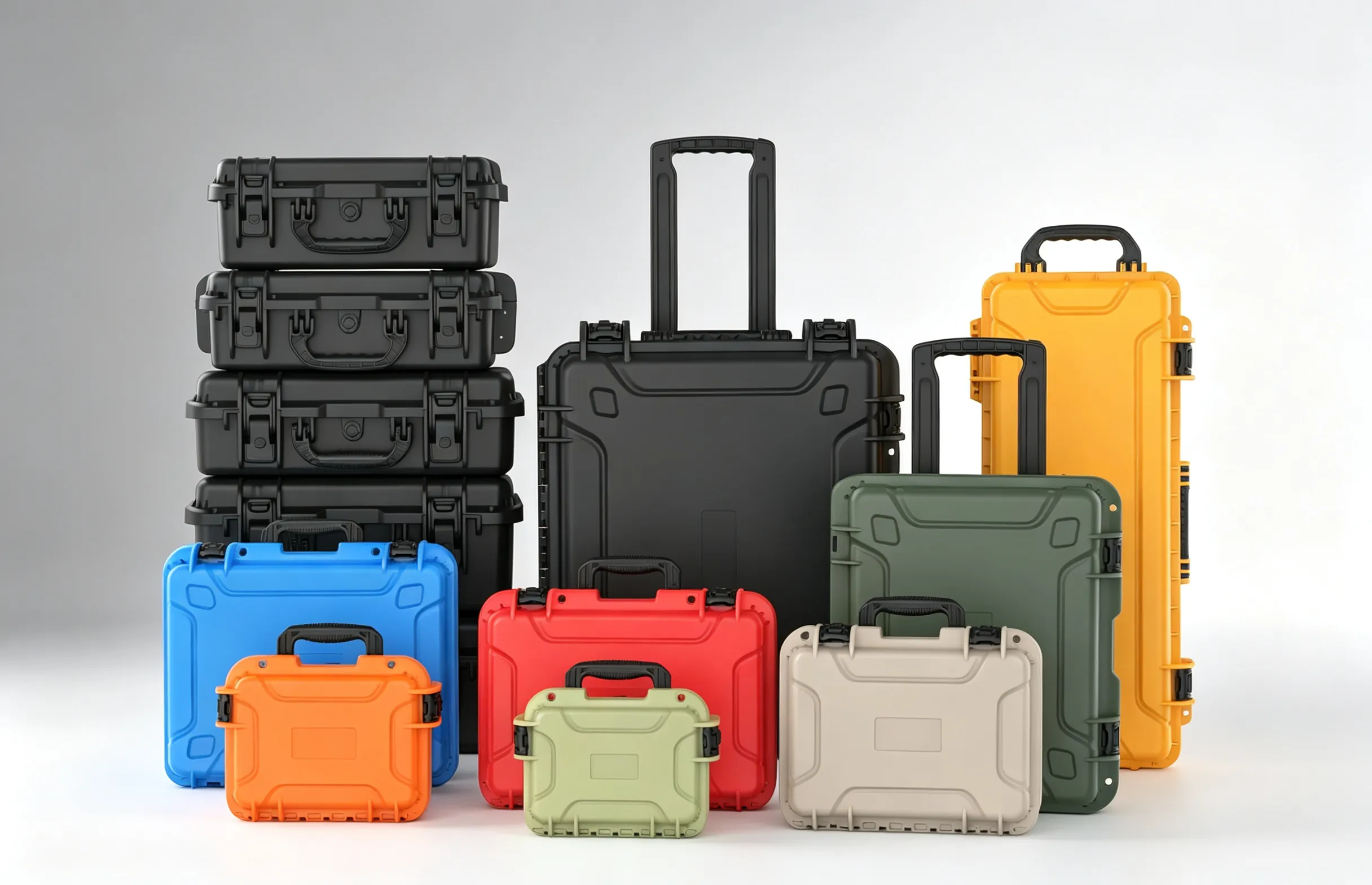
5 Key Takeaways about the Kexin blog
- Industry insights from 15+ years of OEM/ODM experience
- Material comparisons PP / ABS / aluminum / engineering PP
- IP ratings, ATA 300, MIL-STD-810H explanations
- Industry analyses: photo, medical, defense, industrial
- Published in DE / EN / ZH / FR / AR / ES
Latest posts
Industry insights, OEM/ODM guides, material comparisons and market analyses from the Kexin editorial team. We publish 1–2 articles per week on topics relevant to B2B buyers of protective cases.
Summary (TL;DR)
The Kexin blog covers 9 core topics for B2B protective case buyers: (1) OEM vs ODM model selection, (2) IP67/IP68 waterproofing standards, (3) MIL-STD-810H drop test details, (4) custom foam inserts, (5) sourcing from China, (6) ATA 300 air transport readiness, (7) FOB/CIF/EXW shipping options, (8) air freight vs sea freight cost tradeoffs, (9) Kexin 6-step engineering process. Each article contains 4,000+ words, data, FAQ, and concrete recommendations.
Topic comparison (9 articles)
| Topic | Category | Read time | Audience |
|---|---|---|---|
| OEM vs ODM | Model selection | ~12 min | Brands, importers |
| IP67 vs IP68 | Waterproofing | ~10 min | Marine, outdoor, industrial |
| MIL-STD-810H | Drop test | ~10 min | Defense, industrial |
| Custom Foam | Interior | ~8 min | Photo, medical, industrial |
| Sourcing China | Sourcing | ~15 min | Importers, wholesalers |
| ATA 300 | Air freight | ~10 min | Aerospace, defense |
| FOB/CIF/EXW | Logistics | ~10 min | Importers, forwarders |
| Air vs Sea | Transport cost | ~12 min | Importers, logisticians |
| How Kexin | Engineering process | ~12 min | OEM buyers |
Top articles by traffic
- 1. OEM vs ODM Complete Guide — most read 2026
- 2. Sourcing Protective Cases from China — importer favorite
- 3. IP67 vs IP68 Waterproof Rating — marine standard reference
- 4. MIL-STD-810H Drop Test Explained — defense benchmark
- 5. Custom Foam Inserts Guide — interior expert
Protective Case Certifications: What Is Actually Required
REACH, RoHS, ISTA, IP67/IP68, MIL-STD-810H — each test solves a different problem. What belongs in your contract, and ho…
GuideTooling Costs and NRE: When Does a Custom Mould Pay Off?
USD 3,000-10,000 in tooling, 12-16 weeks of lead time. From which quantity a custom mould pays off, who owns the tool, a…
GuideProtective Cases: Total Cost of Ownership Instead of Unit Price
Unit price is only one of five numbers. Replacement, returns, logistics, duty and downtime dominate real cost. Includes …
GuideHow to Audit a Chinese Supplier: A Buyer Checklist
Factory visit, certificate verification, sampling and the warning signs that a supplier is a trading company. Concrete q…
GuideRifle Case B2B Buying Guide: Core Metrics for Professional Buyers
Rifle Case B2B Buying Guide for Military & Law Enforcement / Outdoor Hunting / Tactical Equipment. Covers IP protection,…
Military & PoliceEmergency Transport Case Selection Guide: Core Metrics for B2B Buyers
Emergency Transport Case (EMS Emergency Transport Case) for EMS emergency / hospital transfer / disaster relief. Core se…
EMS First AidPrecision Instrument Case Selection Guide: Core Metrics for B2B Buyers
The Precision Instrument Case is used for industrial precision instruments/laboratories. Core procurement metrics includ…
Precision Industrial InstrumentsPlastic Protection Box Selection Guide: Core Metrics for B2B Buyers
Plastic Protection Box for protective applications. Core purchasing metrics including IP protection, impact resistance, …
General ProtectionEMI Shielding Box Selection Guide: Key Metrics for B2B Buyers
EMI Shielding Box is used for EMI shielding/electronics. Core selection criteria for B2B buyers including IP rating, dro…
Electromagnetic ShieldingAccident Investigation Box Selection Guide: Key Metrics for B2B Buyers
The Accident Box is used for accident investigation. Key purchasing indicators including IP protection, drop test, mater…
Accident InvestigationAED Protective Box Selection Guide: Key Metrics for B2B Buyers
The AED Box is used for automated external defibrillators. Key purchasing indicators including IP protection, drop test,…
DefibrillatorAED Defibrillator Case Selection Guide: Key Metrics for B2B Buyers
AED Defibrillator Case for public spaces / EMS emergency / hospital emergency. Core purchasing metrics including IP prot…
Public SpacesLatest posts — all 418 posts
Blog categories
All blog posts are organized into the following topic areas. Click a category to view related articles.
- Protection standards — IP67/IP68, MIL-STD-810H, ATA 300, IEC 60529, ISO 2859-1, AQL 1.0/2.5
- OEM/ODM process — 7 steps from briefing to shipping, tooling cost, DFM, CAD, sample
- Sourcing & logistics — Factory audit, MOQ, payment, EXW/FOB Shenzhen/Ningbo shipping
- Industry applications — Industrial MRO, photo/video, drones, medical, defense, marine, outdoor
Publication schedule
The Kexin blog is updated 1-2 times per week. New articles include technical analyses, OEM/ODM guides, material comparisons, logistics optimization, and market trends. Subscribers receive weekly summaries via email. For topic suggestions: [email protected].
About the Kexin blog
The Kexin blog is written by the engineering team of our protective case source factory in Guangdong. With 15+ years of experience in OEM/ODM protective case manufacturing, the Kexin Engineering Team (12 specialists, 5 senior engineers) shares practical insights from 1,000+ OEM projects, 30+ export countries, and 7 industry sectors. All articles are based on real projects, documented test reports, and verifiable data — not hypothetical scenarios. Kexin has delivered EXW Guangdong or FOB Shenzhen/Ningbo worldwide since 2010, with ISO 9001:2015 certification, and AQL 1.0/2.5 quality control per lot. This blog complements the product pages with technical depth for B2B buyers, engineers, and quality managers who need to make informed decisions. For inquiries: [email protected], +86 135 3588 0002.
Bookmarks & updates
Bookmark this blog index to see the latest technical articles on the protective case market. We update existing articles when standards change (e.g. new IP68 depths, MIL-STD-810 revisions, REACH updates). Kexin recommends using current versions for certification, sourcing, and engineering decisions.
FAQ about the blog
How often are new articles published?
1-2 times per week, with focus on technical analyses and OEM/ODM guides.
Who writes the articles?
Kexin Engineering Team (12 specialists, including 5 senior engineers with 10+ years experience). All authors have 15+ years of OEM/ODM experience.
Can I suggest an article?
Yes, send your topic suggestion to [email protected]. We review requests on business days.
Are articles technically reviewed?
Yes, each article is reviewed by at least two engineers and one external reviewer before publication. Updates on standard changes are date-marked.
Can I use older articles as reference?
Articles are date-marked. For standards like IP67/IP68 (IEC 60529) or MIL-STD-810H that have not fundamentally changed over the years, older articles remain valid. For certification decisions, we recommend checking the current revision directly with the manufacturer or an independent source like TÜV or SGS.
Does Kexin also offer custom whitepapers?
Yes, for OEM customers with 5,000+ pieces annual volume, we create free whitepapers for your specific application, including benchmark comparisons with alternative materials, lifetime projections, and ROI calculations. Contact: [email protected].
Are articles translated into other languages?
Yes, all articles appear in parallel in DE / EN / ZH / FR. Translations are produced by native-speaking engineers and marketing experts to ensure technical accuracy in each language. Updates are synchronized across all 4 languages.
Current trends 2026
The protective case market in 2026 is evolving in several directions: (1) Sustainable materials — bio-based PP compounds and recycled PP are increasingly demanded by European brands. (2) Smart cases — integrated IoT sensors for temperature, humidity, shock, and GPS tracking in defense and pharmaceutical applications. (3) Modular interiors — quickly exchangeable foam modules for multi-device kits in metrology. (4) Faster lead times — local 3PL warehouses in DE/EU/US are becoming more important for just-in-time delivery. (5) Higher IP ratings — IP68 at 5 m depth is increasingly standard in premium series. Kexin actively follows these trends and adapts the product portfolio accordingly.
Industry guides & resources
In addition to this blog, Kexin provides comprehensive industry guides and technical resources for B2B buyers. These materials are available free of charge and updated regularly.
- OEM design guide — 150+ page PDF with case wall thickness, latch types, hinge selection, IP rating recommendations by industry and typical use cases. Includes CAD templates, form factor tables, and tooling cost calculator.
- Material comparison tool — Online tool to compare PP, ABS, PC, aluminum, HDPE, EVA by density, impact strength, temperature range, IP suitability, chemical resistance, UV resistance, recyclability, and cost factor.
- Certification checklist — Complete checklist of required certifications by industry and region: CE/RoHS/REACH for EU, FCC for USA, PSE for Japan, RCM for Australia, KC for South Korea, CCC for China.
- Sourcing risk analysis — PDF risk matrix for sourcing from China: IP protection (NDA, tooling ownership), quality assurance (AQL, PSI), communication, logistics, customs.
Quality standards & compliance
Kexin New Material operates a 12,000 m² production area in Guangdong with 6 PP/ABS injection production lines, 2 aluminum CNC production lines, 1 foam CNC line, and 2 assembly lines. Annual capacity: 1.5 million cases. Our production line follows a documented AQL 1.0/2.5 sampling system per ISO 2859-1, a 4-stage QC chain (IQC → IPQC → FQC → OQC), IP67/IP68 water ingress tests per IEC 60529, and MIL-STD-810H environmental testing. Standard certificates: CE, RoHS 2/3, REACH, ISO 9001:2015.
7-step OEM process
Our standard OEM process follows 7 steps: ① Briefing & quote (24 h) → ② DFM & 3D CAD → ③ Sample 7–10 days → ④ Tooling from USD 3,000 → ⑤ Mass production 30–45 days → ⑥ AQL quality control → ⑦ EXW Guangdong or FOB Shenzhen / Ningbo. Tooling from USD 3,000 one-time, MOQ 500 pieces for Pantone color and logo.
Frequently asked questions
How does OEM ordering work?
7 steps: Briefing → DFM → Sample → Tooling (from USD 3,000) → Production → AQL QC → EXW/FOB Shenzhen/Ningbo. MOQ 500 pieces, lead time 30–45 days.
Which materials do you offer?
PP, ABS, PC, aluminum, HDPE, EVA. PP and ABS are most common for OEM series, aluminum for premium and defense applications.
Which certificates and tests are available?
CE, RoHS 2/3, REACH, ISO 9001:2015 standard. IP67/IP68 (IEC 60529) and MIL-STD-810H on request per lot.