How to choose case size & dimensions — B2B selection guide 2026
5 Key Takeaways: How to choose case size & dimensions — B2B selection guide 2
- Topic: guide — industry context for B2B buyers and procurement teams
- Date: 2026-09-04 — current standards, certifications and market conditions
- Applications: protective cases for industrial tools, MRO, photography, drones, defense, medical devices, marine, audio
- Procurement: MOQ 500 pieces per Pantone color, 30–45 days lead time after tooling approval, CE/RoHS/REACH/ISO 9001/BSCI
- Shipping: EXW Guangdong (pickup) or FOB Shenzhen / Ningbo (sea freight). 28–35 days to Hamburg / Rotterdam
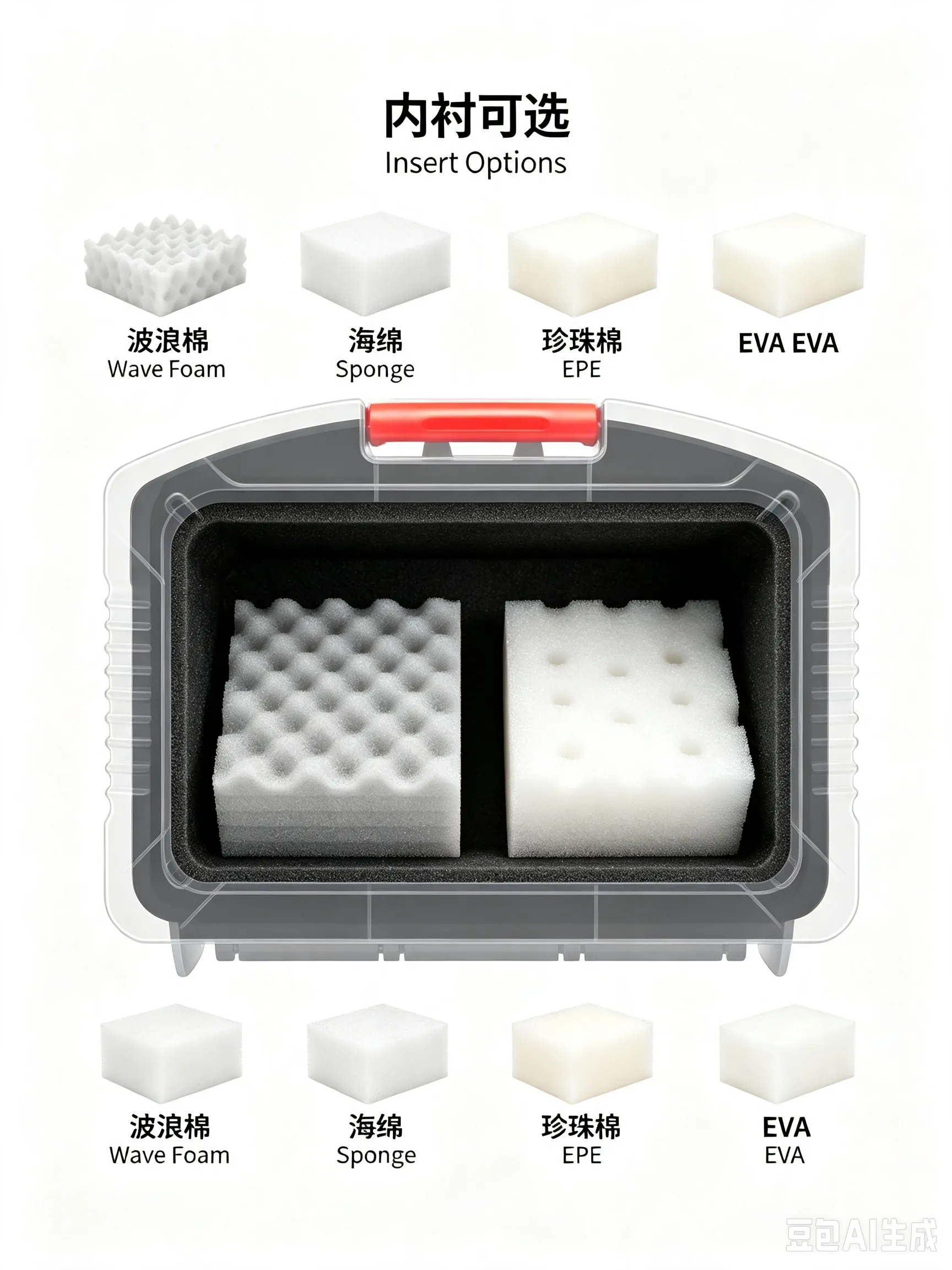
Choosing the right case size is the most important decision in B2B procurement: a too-small case won't fit equipment, a too-large case wastes foam, material, and shipping cost. This guide gives B2B buyers a systematic method.
Key dimensions terminology
- Outer dimensions: complete case including hinges, latches, handle (LxWxH)
- Inner dimensions: usable space inside the case (LxWxH)
- Lid depth: how far the lid inserts into the case when closed (typically 25-50mm)
- Base depth: bottom half of the case, where equipment sits (typically 50-100mm)
- Total inner usable: inner dimensions - lid depth (vertical)
- Effective inner: inner dimensions - foam thickness (typically 10-20mm each wall)
The 10% padding rule
Always size your case to be 10% larger than your equipment on each dimension.
Example: equipment 300×250×150mm
- Minimum effective inner space: 330×275×165mm
- Recommended case: 350×300×180mm or larger (more foam, more protection)
This 10% padding gives:
- 5mm foam on each wall (10mm total around perimeter)
- Room for cable management, accessories, foam gaps
- Tolerance for equipment manufacturing variances (±1-2mm per dimension)
- Better shock absorption (more foam = more deceleration distance)
Equipment measurement workflow
Step 1: List your equipment
- Each item: model, dimensions (L×W×H), weight, fragile areas
- Accessories: cables, chargers, manuals, mountings
- Foam-fitting: where connectors are, where foam should compress
Step 2: Group by usage
- Option A: All-in-one case (all equipment together) — bigger case
- Option B: Modular cases (one per item) — multiple smaller cases
- Option C: Hybrid (main + accessories) — 2 cases
Step 3: Measure critical dimensions
- For irregular equipment: measure in 3 axes
- Add 5-10mm clearance for foam + handling
- Round up to nearest 50mm (case standard sizes)
- Check for height-with-handle (handle adds 30-50mm above equipment)
Step 4: Verify clearance
- Foam density: PE 18-30 kg/m³ compresses 10-15% under load
- Equipment weight: heavier items need denser foam (less compression)
- Connector clearance: 5-10mm minimum for plug access
Standard case sizes (Kexin 6-series reference)
| Model | Outer (mm) | Inner (mm) | Weight empty | Typical use |
|---|---|---|---|---|
| 6-2010 | 215×165×95 | 190×140×75 | 0.4 kg | Compact electronics, GPS |
| 6-2810 | 280×195×110 | 250×165×90 | 0.6 kg | DSLR body + lens |
| 6-3618 | 365×265×185 | 335×235×155 | 1.1 kg | Camera + accessories |
| 6-4020 | 410×305×195 | 380×275×170 | 1.4 kg | Multi-lens camera kit |
| 6-5020 | 510×390×210 | 475×355×185 | 2.0 kg | Cinema camera + monitor |
| 6-6030 | 600×430×300 | 565×395×270 | 2.8 kg | Drone + 4 batteries |
| 6-7030 | 700×490×300 | 660×450×270 | 3.5 kg | Video equipment set |
Common mistakes
Mistake 1: Sizing to equipment exact dimensions
Equipment at 298×248×148mm needs 350×300×180mm case (52mm extra on length). Buyers often pick 300×250×150mm case, then can't fit foam + 5mm clearance.
Mistake 2: Ignoring handle/connector protrusion
Equipment with cables attached may be 30-50mm taller. Always measure with all accessories attached.
Mistake 3: Forgetting lid insert depth
Lid takes 25-50mm vertical space. If lid is 30mm and base is 100mm, total internal is 130mm but usable is only 100mm tall.
Mistake 4: Mixing units
Sometimes specs are in inches (1 inch = 25.4mm). Kexin specifies mm. Always double-check.
Mistake 5: Over-specifying
Oversized case is heavier, more foam needed, more expensive to ship. Stick to smallest case that fits with 10% padding.
OEM case size customization
If standard sizes don't fit, Kexin offers:
- 50mm increments (e.g. 450×350×200mm not available, but 500×350×200mm is)
- Full custom: any L×W×H, MOQ 500 pieces, mold fee USD 3,000-8,000
- Hybrid: 6-series with 8-series depth (e.g. 6-5023 with 8-5023 internal layout)
- 9-series HD: extra-deep for tall equipment
Lead time: standard sizes 30-45 days, custom 60-90 days (mold production + sampling + production)
Multi-case systems
For 5+ pieces of equipment, consider modular:
- 1 large case: bulk equipment (5-10 kg) — less efficient packaging, heavier case
- 2-3 medium cases: by function (camera + lenses, audio + mics, drone + batteries) — better foam efficiency
- Stackable design: cases stack on top of each other (saves pallet space)
Sample data calculation
Order 6-5020 case (510×390×210mm outer, 475×355×185mm inner):
- Empty case weight: 2.0 kg
- Add EPE foam (5mm each wall + 30mm base): ~0.4 kg
- Add CNC foam insert (custom): ~0.6 kg
- Total empty + foam: 3.0 kg
- Equipment (e.g. ARRI Amira + 4 lenses): ~8 kg
- Loaded weight: ~11 kg
- Foam compression under 8kg load: 8% (PE 25 kg/m³)
- Effective inner after compression: 460×345×170mm (still 10% padding for 400×310×155mm equipment)
Weight vs dimensions trade-off
For air freight, every 1kg added weight adds USD 3-5/case in shipping cost. For 1,000-piece order:
- 5kg heavier case: USD 3,000-5,000 extra shipping
- 5kg lighter case: same savings + easier handling
- Choose smallest case that fits, with right foam
Common B2B scenarios
Scenario 1: Drone (DJI Matrice 350 RTK)
- Equipment: 500×450×200mm (drone + RC + 2 batteries + cables)
- Add 50mm clearance each side: 600×550×250mm
- Standard case: 6-7030 (700×490×300mm outer, 660×450×270mm inner)
- Or custom: 6-5023 extended (custom dimensions 600×500×250mm)
Scenario 2: Cinema camera (ARRI Alexa Mini)
- Equipment: 350×200×150mm (body) + 400×300×100mm (monitor + cables)
- Combined: 400×350×200mm
- Case: 6-5020 (475×355×185mm inner, lid takes 30mm → 155mm usable)
- Need 6-5023 (475×355×230mm, 200mm usable) instead
Scenario 3: Medical device (portable ultrasound)
- Equipment: 400×350×80mm
- Add 50mm: 450×400×130mm
- Case: 6-4517 (450×355×170mm inner)
Bottom line
Apply the 10% padding rule, use Kexin standard sizes when possible, and add 5mm foam on each wall. For complex multi-equipment kits, contact Kexin engineering for free layout consultation.