Tooling Costs and NRE: When Does a Custom Mould Pay Off?
5 Key Takeaways: Tooling Costs and NRE: When Does a Custom Mould Pay Off?
- Topic: guide — industry context for B2B buyers and procurement teams
- Date: 2026-10-01 — current standards, certifications and market conditions
- Applications: protective cases for industrial tools, MRO, photography, drones, defense, medical devices, marine, audio
- Procurement: MOQ 500 pieces per Pantone color, 30–45 days lead time after tooling approval, CE/RoHS/REACH/ISO 9001/BSCI
- Shipping: EXW Guangdong (pickup) or FOB Shenzhen / Ningbo (sea freight). 28–35 days to Hamburg / Rotterdam
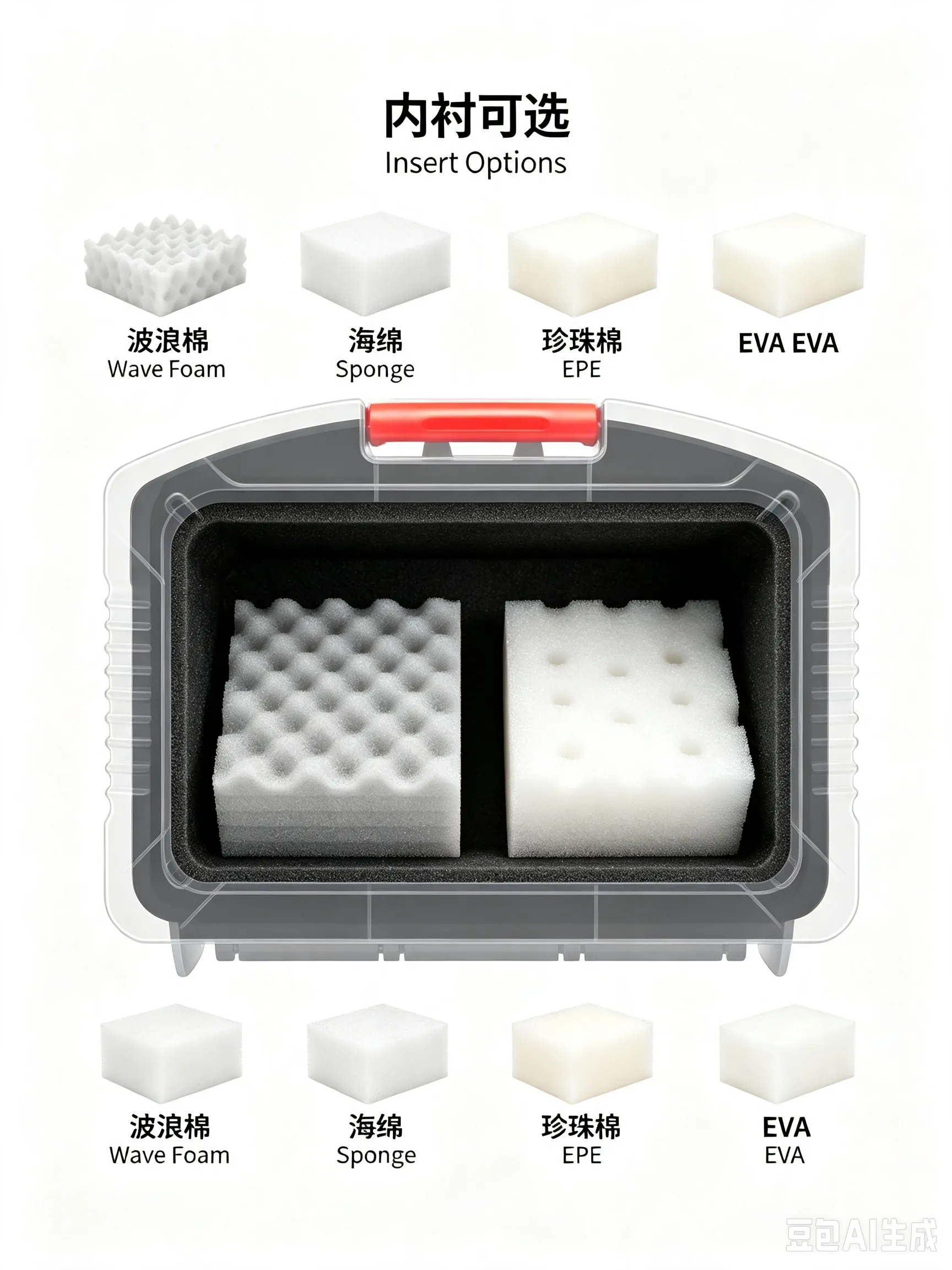
Direct answer: Tooling runs roughly USD 3,000-10,000 per tool and 12-16 weeks from drawing to production-ready. It amortises once you buy enough units. The arithmetic is simple: total cost of ownership with your own tool equals the tool cost divided by units ordered, plus the unit price. With tooling at USD 6,000 and a factory price of USD 9 on an ODM version, the crossover sits near 1,200 units. Below that, buy the stock design; above it, the tool pays for itself — and then some.
What the tooling cost is actually made of
- Mould design and simulation — 5-10 % of total. This is the part worth paying for. A proper fill and warp simulation catches sink marks and short shots before steel is cut.
- Steel and machining — 30-40 %. Tool steel grade determines cycle time and wear life. Cheaper grades are only sensible for low volume.
- Cavity count — the biggest lever. A single-cavity tool costs roughly half a two-cavity tool but takes twice as long per shot. This is a throughput decision, not a cost decision, and it depends on your volume, not your budget.
- Insert features — snap fits, bosses, lanyard lugs, draft angles. Each insert adds cost and adds failure modes.
- Trial and correction — 15-25 %. Nobody gets a complex case mould right on the first shot. A supplier quoting "no correction" is quoting one error rate for steel and another for you.
Running the amortisation properly
The mistake most buyers make is dividing tooling by the first order quantity. It is a three-year number.
Worked example. Tooling USD 6,000, your unit price with the tool USD 9.20, factory price on the closest ODM shell USD 7.80. The saving per unit is USD 1.40, so the tool pays back at 6,000 / 1.40 = 4,286 units. If you expect 8,000 units over three years, the tool is clearly right. If you expect 2,000, it is clearly wrong — and the right move is to ask whether the custom design is worth USD 0.40 per unit for a feature you genuinely need.
Two refinements matter. First, count repeat orders, not one order. Second, add the cost of getting it wrong: a tool modified twice costs more than a tool that was specified properly the first time.
Who owns the tool
Default should be: you pay for it, you own it, it stays at the supplier's plant under your name, and the supplier may not use it for anyone else. Kexin works this way: custom tools remain the customer's property and remain on site. Three things to write down:
- The tool is identified with your name or asset number and is listed in our tool register.
- The supplier may not copy the design, the geometry or the branding to another customer.
- You may move the tool if you change supplier, on written notice, at a stated handling cost.
A tool you do not own, from a supplier you cannot switch, is not an asset — it is a dependency.
Tool acceptance: what to check before you cut the order
Accept or reject the first tool before paying the balance. This is the last cheap moment to fix anything.
- Dimensions. Critical walls, the parting line, the hinge boss and the latch engagement must match the drawing, not just "look right".
- Shrinkage. Plastic shrinks as it cools. If the tool was built to nominal rather than to compensated shrinkage, every part will be off.
- Draft and parting line. Poor draft does not fail on the sample, it fails at 30,000 parts with flash and sink marks.
- Cooling channels. Uneven cooling means warpage. Ask where the channels are, not just that cooling exists.
- Fit to your finished product. Fit the first parts to the real case, foam and hardware before approving.
When not to tool at all
Use an existing tool from the 200+ designs we already have. That is what ODM is for: you get your logo, colour and foam insert on a proven geometry, with tooling cost near zero and a 4-6 week lead time instead of 12-16. Most first orders should go this way. Tool only when the geometry itself is the differentiator — a case nobody else can copy, where the shape is your competitive advantage rather than your packaging.