How to Audit a Chinese Supplier: A Buyer Checklist
5 Key Takeaways: How to Audit a Chinese Supplier: A Buyer Checklist
- Topic: guide — industry context for B2B buyers and procurement teams
- Date: 2026-09-30 — current standards, certifications and market conditions
- Applications: protective cases for industrial tools, MRO, photography, drones, defense, medical devices, marine, audio
- Procurement: MOQ 500 pieces per Pantone color, 30–45 days lead time after tooling approval, CE/RoHS/REACH/ISO 9001/BSCI
- Shipping: EXW Guangdong (pickup) or FOB Shenzhen / Ningbo (sea freight). 28–35 days to Hamburg / Rotterdam
Direct answer: Audit a supplier before you place a repeat order, not after. The four things you can actually verify in one day are: whether the production lines belong to them, whether the test reports match the exact model, whether the workshop output matches the claimed capacity, and whether the people answering your questions can explain the process without reading your slides.
Trading company or factory
The single most common problem is a supplier that presents a trading company as a manufacturer. It is legal, and many are excellent partners, but the price, the lead time and the quality record are not theirs to control. Signs to watch for on a visit:
- No injection moulding machines visible on the floor, or machines that are clearly idle and dusty.
- A production area too small for the monthly volume they quote.
- Workers who cannot tell you which mould belongs to your product.
- Quality staff who fetch the test report from a drawer and hand it over without knowing the batch number.
- An inability to let you see the raw material store, which is where a real factory has nothing to hide.
A genuine factory will often volunteer the limitation itself. If someone says "we run two shifts and the 15,000-piece monthly volume is handled by a partner plant in Dongguan", you have learned something useful. If nobody can name the sub-supplier, treat that as a risk.
The on-site checklist
1. Entry and layout.Does the site look like a working factory or a showroom? Look for material flow, a goods-in area, a warehouse with racking, and a separate QC bench.
2. Machines.Note the number of injection moulding machines, their tonnage and their brand, and the compression moulding press if any. Compare the total shot weight capacity against the volume you plan to order. A 2,000-tonne press cannot produce a part that needs 3,000 tonnes.
3. Tooling.If they claim existing moulds, ask which ones, ask to see them, and check whether they are marked with the customer name. Bring the part drawings and ask them to show you the mould cavity corresponding to your part number. A plant without your mould is a plant that buys from somewhere else.
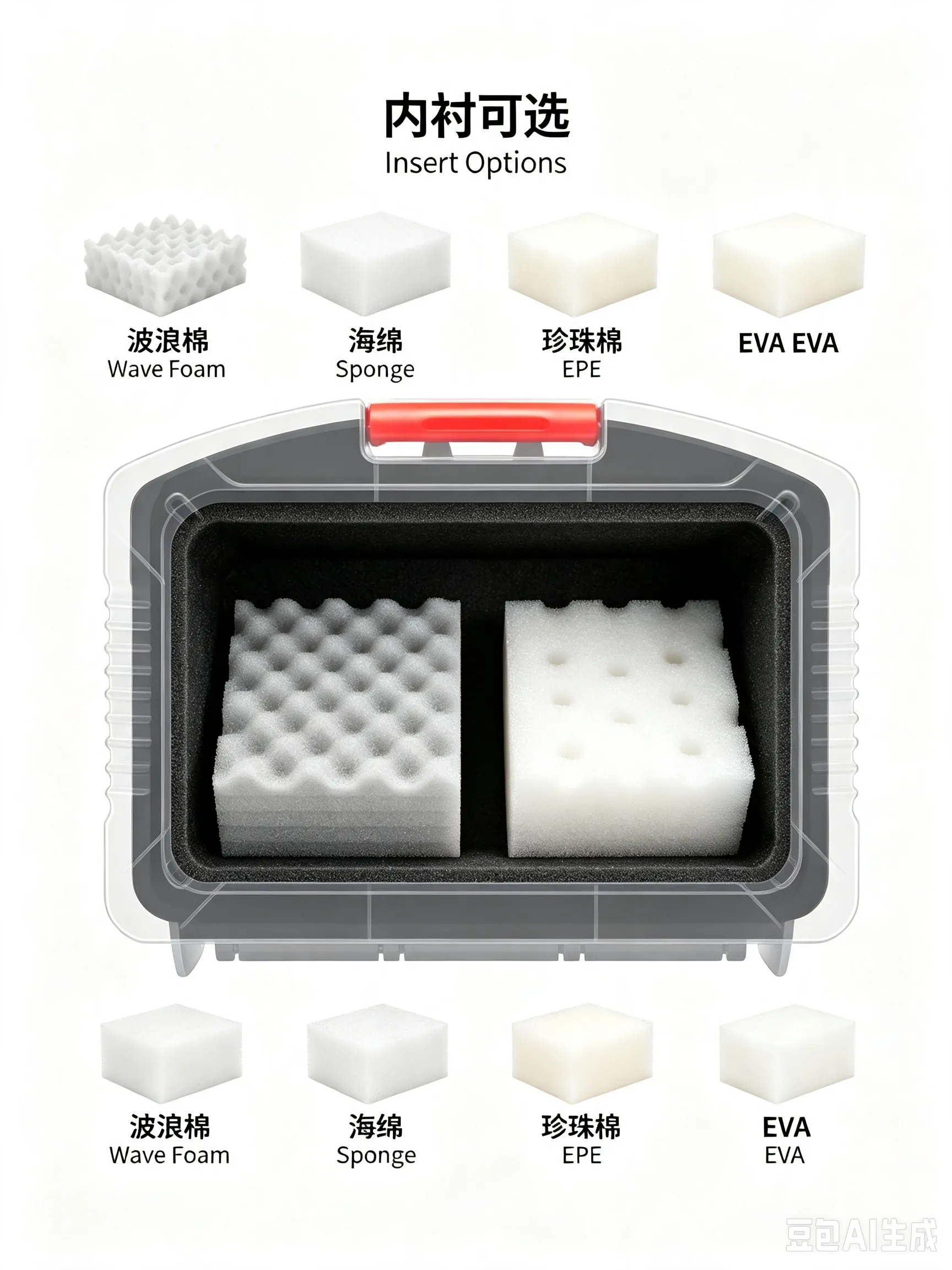
4. Workmanship in progress.Open cases. Look at the parting line, the hinge boss, the foam fit, the lanyard attachment and the seal compression. These are the details that tell you whether the plant controls its own quality rather than accepting whatever the mould produces.
5. QC bench.Do they have gauges, a torque meter, an IP test setup and a scale? Are there records, or only a verbal assurance?
Verifying certificates and test reports
A test report is a piece of paper. Verify four things:
- The model.Does the report reference your exact model number, or only a series? A report for a different shell is worthless for your part.
- The lab.Which laboratory performed it? Ask for the report number and check it directly with the laboratory rather than only against the supplier PDF.
- The date.Is it inside your qualification window? A five-year-old report may predate a material change.
- The scope.Does it test what you care about? An IP rating is a water test, not a drop test. MIL-STD-810H has separate methods for drop, vibration, temperature and immersion.
At Kexin we provide test reports that name the model, the laboratory and the method, and we are willing for you to verify the report number with the issuing laboratory.
Sampling and pre-production approval
Before series production, approve a golden sample in writing. It defines what "correct" means, and it is the reference used when a dispute arises. Production follows ISO 9001:2015 with AQL 1.0 for critical and 2.5 for major characteristics. For batches of 500 pieces or more, an independent inspection by an agency such as SGS, BV or TÜV can be booked. That is a small cost compared with discovering a defect after the goods are on the water.
Red flags that mean stop
- The supplier refuses a video walkthrough of the production floor before you travel.
- Payment is demanded in full before any production, with no proforma and no inspection stage.
- Nobody can produce a drawing, a sample or a previous order number for a "custom" product.
- The factory address changes between the quotation and the invoice.
- Pressure to skip the sample stage, or to pay the tooling fee by bank transfer to a personal account.
None of these rules out a good supplier, but each one deserves an explanation before you send money. A factory that is genuinely manufacturing will have the records, the people and the equipment to answer all of this on site.
Working with Kexin
We run a 12,000 m² factory in Guangdong with injection moulding, compression moulding, foam CNC cutting, assembly and a QC bench in-house. Our 8-series is tested to IP67/IP68 and MIL-STD-810H, and reports name the model, the laboratory and the method. We quote EXW Guangdong or FOB Shenzhen/Ningbo, we issue a proforma invoice after the deposit, and from 500 pieces you can visit the line or book an independent inspection.