Injection molding process for protective cases — 2026 B2B guide
5 Key Takeaways: Injection molding process for protective cases — 2026 B2B gu
- Topic: guide — industry context for B2B buyers and procurement teams
- Date: 2026-09-04 — current standards, certifications and market conditions
- Applications: protective cases for industrial tools, MRO, photography, drones, defense, medical devices, marine, audio
- Procurement: MOQ 500 pieces per Pantone color, 30–45 days lead time after tooling approval, CE/RoHS/REACH/ISO 9001/BSCI
- Shipping: EXW Guangdong (pickup) or FOB Shenzhen / Ningbo (sea freight). 28–35 days to Hamburg / Rotterdam
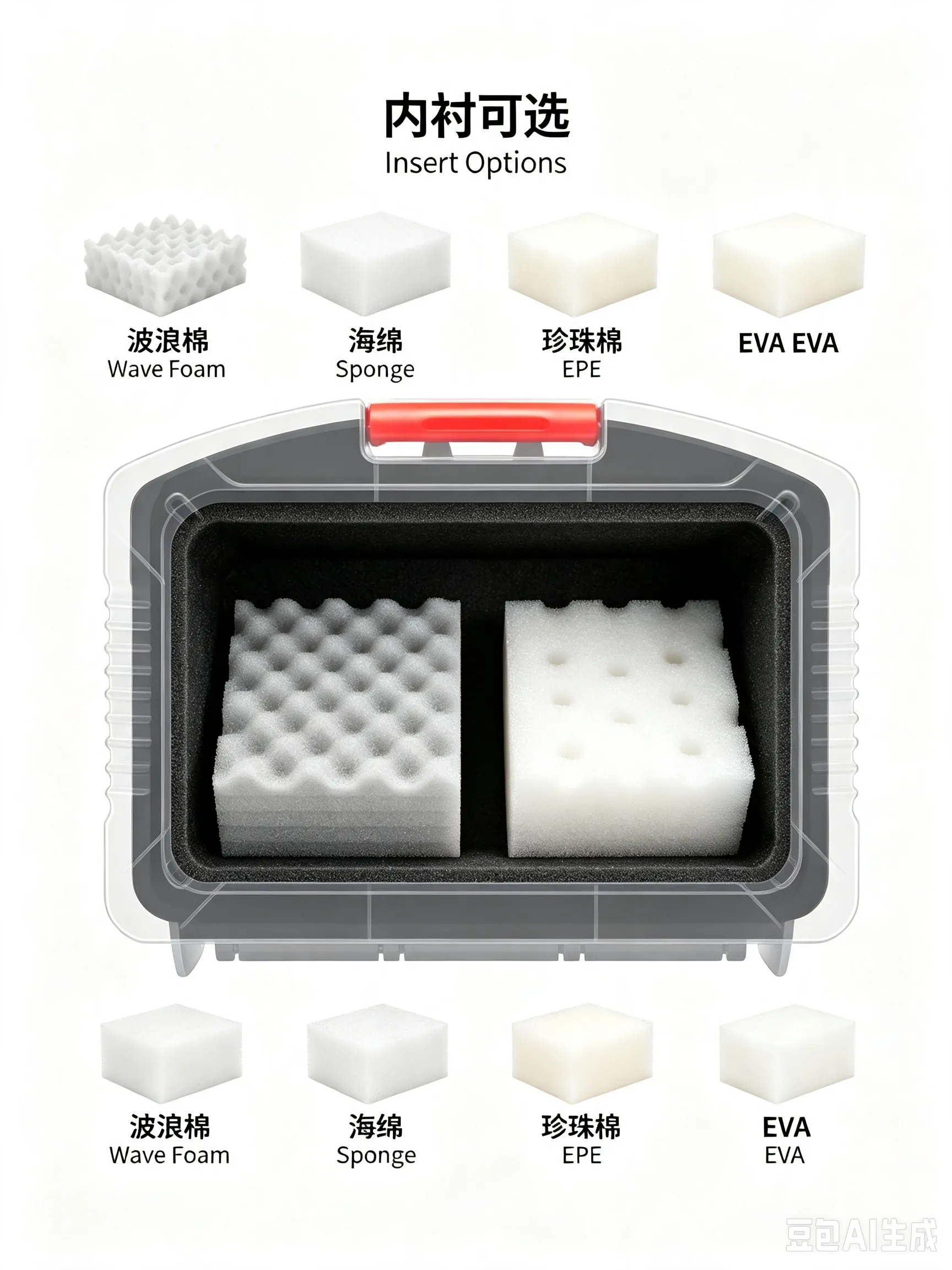
Injection molding is the dominant production process for plastic protective cases (PP, ABS, HD-PE). This B2B guide covers machine types, mold design, process parameters, cycle time, and quality control for buyers evaluating suppliers.
Machine types by tonnage
Small cases (< 400×300×200mm)
- Machine: 50-200 ton clamping force
- Shot weight: 100-500 g
- Cycle time: 25-45 seconds
- Kexin uses: Haitian Mars II 90T, 150T, 200T
- Cavitation: 1-2 per mold (for low MOQ flexibility)
Medium cases (400-600mm)
- Machine: 250-500 ton
- Shot weight: 500-1,500 g
- Cycle time: 45-90 seconds
- Kexin uses: Haitian 380T, 500T
- Cavitation: 1 per mold (large parts)
Large cases (> 600mm, e.g. 9-series HD trolley)
- Machine: 800-1,600 ton
- Shot weight: 2,000-5,000 g
- Cycle time: 90-180 seconds
- Kexin uses: Haitian 1,200T, 1,600T
- Special: 2-shot molding for hard-soft combinations
Mold design basics
Cavity count trade-off
- 1 cavity: lowest mold cost (USD 3,000-5,000), slowest production (5-10 sec per shot, total cycle = single cycle)
- 2 cavities: balanced, USD 5,000-8,000, 50% faster than 1-cavity
- 4 cavities: USD 10,000-15,000, 75% faster but requires precise flow balance
- 8+ cavities: high-volume only (10,000+ pieces), USD 25,000+, requires hot runner system
Kexin default: 1 cavity for OEM (low MOQ flexibility), 2 cavities for ODM/White-label
Mold material
- P20 steel: standard, 200,000-500,000 shots lifetime
- H13 steel: pre-hardened, 1M+ shots, higher cost
- S136 stainless: medical/food grade, corrosion-resistant
- Aluminum: prototype only, 5,000-10,000 shots
Cooling channels
- Conformal cooling (3D printed): -30% cycle time, +50% mold cost
- Standard drilled channels: baseline
- Beryllium copper inserts: for hot spots, +USD 2,000-5,000 per insert
Process parameters
Temperature
- PP: melt 200-260°C, mold 20-60°C
- ABS: melt 220-260°C, mold 40-70°C
- HDPE: melt 200-240°C, mold 20-50°C
- Mold temperature: critical for surface finish, warpage, cycle time
Pressure
- Injection pressure: 800-1,500 bar (typical)
- Holding pressure: 30-60% of injection, 5-15 seconds
- Back pressure: 5-30 bar (controls melt homogeneity)
Speed
- Injection speed: 30-100 mm/s (faster = better surface, more flash risk)
- Screw speed: 50-150 rpm (plasticizing)
Cycle time breakdown
| Phase | Duration | Variables |
|---|---|---|
| Mold close | 2-5 s | Clamp speed |
| Injection | 1-3 s | Shot size, pressure |
| Holding | 5-15 s | Part thickness |
| Cooling | 15-60 s | Wall thickness, mold temp |
| Plasticizing | 5-15 s | Screw design, melt temp |
| Mold open | 2-3 s | Ejector design |
| Part ejection | 1-2 s | Automation |
| Total | 30-100 s |
Quality control checkpoints
IPQC (in-process)
- Every 50 shots: visual + dimensional check (3-5 key dimensions)
- Every 200 shots: full AQL 2.5 sample (50 pieces)
- Every shift: Cpk verification on critical dimensions
Critical dimensions to monitor
- Wall thickness: ±0.3mm typical tolerance
- Latch force: 8-15 N (depending on series)
- Hinge torque: 5-10 N (depending on series)
- Color: ΔE ≤ 3.0 vs. Pantone reference
- Surface finish: SPI-A2 to SPI-B3 (Ra 0.2-1.6 μm)
Common defects and solutions
Sink marks (depressions on thick sections)
- Cause: insufficient packing pressure, too short hold time
- Solution: increase holding pressure +20%, add cooling time
Flash (excess material at parting line)
- Cause: clamp force too low, worn mold
- Solution: reduce injection speed, check clamp tonnage, polish mold surfaces
Weld lines (visible flow fronts meeting)
- Cause: low melt temperature, slow injection
- Solution: increase melt temp +10°C, faster injection
Warpage
- Cause: uneven cooling, residual stress
- Solution: longer cooling time, balanced mold temperature, annealing
Short shots (incomplete filling)
- Cause: insufficient material, low pressure, blocked gates
- Solution: increase shot size, check gate cleanliness
Burn marks (dark spots)
- Cause: trapped air, excessive injection speed
- Solution: add venting, reduce speed
Cycle time optimization
Kexin 2026 best practices:
- Conformal cooling on high-volume molds: -25% cycle time
- Hot runner system: -15% cycle time + no runner waste
- Servo-electric machines: -20% energy + faster response
- Parallel operations: insert + eject during closing
Material flow analysis
Kexin uses Moldflow simulation for:
- Gate location optimization
- Weld line prediction
- Cooling time estimation
- Warpage prediction
- Pressure drop calculation
Recycled material processing
- 35% rPP in 6-series: requires melt filtration (60-100 mesh), cycle time +10%
- 50% r-aluminum in 8-series: aluminum is machined, no melt processing
- Bio-PP: slightly higher melt viscosity, +5°C melt temp
Industry 4.0 / smart manufacturing
- Real-time process monitoring (pressure, temp, position)
- Statistical process control (SPC) dashboards
- AI defect detection via vision system (5 cameras per line)
- Predictive maintenance (vibration analysis on tie bars)
- MES (Manufacturing Execution System) integration
Kexin: 4 of 6 injection lines have Industry 4.0 monitoring (2026 plan: 6 of 6)
Capacity calculation example
500 pieces of 8-series 5023 (500×350×230mm, 1.2kg shot weight):
- Cycle time: 75 seconds (with conformal cooling)
- Available hours: 16h/day × 2 shifts × 30 days = 960h/month = 57,600 min/month
- 1-cavity mold: 57,600/75 = 768 shots/month = 768 pieces
- 2-cavity mold: 1,536 pieces/month
- For 500 pieces delivery: 1-cavity works (less than 1 month)
B2B buyer checklist
When visiting a factory, ask:
- How many injection lines? (5+ for serious factory)
- Machine age? (5-10 years is fine; > 15 years is concerning)
- Clamp tonnage range? (covers all series you need?)
- Hot runner availability? (essential for high-volume)
- In-house mold maintenance? (vs. outsourced)
- Mold storage capacity? (5,000+ molds for serious OEM)
- Cpk data on critical dimensions? (target Cpk ≥ 1.33)
- First pass yield (FPY)? (target ≥ 95%)
- Internal scrap rate? (target < 2%)
- Industry 4.0 monitoring? (best practice but not required)
Bottom line
Injection molding is a mature process; the differentiator for B2B buyers is:
- Cycle time (drives unit cost)
- Cpk (drives quality)
- Mold maintenance (drives delivery reliability)
- Capacity (drives MOQ flexibility)
Kexin offers 6 injection lines (90T-1,600T), 95% FPY, 1.8% scrap, in-house mold maintenance, and 4/6 lines with Industry 4.0 monitoring as of 2026.